
I recently caught up with a long-time friend from out of town. As we chatted, he filled me in on his family, including his youngest child, who is still in high school. She is a star athlete, and he explained that they had just endured the first day universities were allowed to offer her scholarships and "name, image, and likeness" compensation. He said on that very first day, they were on the phone or on Zoom calls for twelve straight hours, fielding offers from every major university on her interest list.
He told me it was obviously a great blessing for their family, but all a tad overwhelming as they now head into the hard work of decision-making. How would they make a decision between so many great options? In the Old Testament, when Israel had a difficult leadership or military decisions to make, the priest would use a mysterious device called the Urim and Thummim (Ex. 28:30) to discern the will of the Lord, so I joked with him that if he didn't have one, he could borrow mine.
Of course, we live in a different era from those Old Testament priests. As believers, we have the Spirit of God living within us (the Spirit's internal input), the full and accessible canon of Scripture (the Scripture's input), along with a worldwide church rather than a centralized temple (godly people's input). Yet, for all these benefits that should (and do) help us with decision making, the sheer number of decisions coming our way can feel daunting.
And modern live's of relative abundance only add to the complexity because we have a myriad of choices to make that our previous generations didn't. Our mobility, our ability to live in so many different places, our freedom to travel, compounds our decision fatigue. Dating apps. Thousands of fashion styles. A hundred million songs at our fingertips. An endless stream of updates, articles, and books to peruse. An impossible amount of media to engage with. A myriad of live sports readily available. A barrage of advertisements. Constant church offerings and opportunities. The deeper longings of the soul. A sense within us that something isn't quite right. The ache to have what our neighbor has. How to raise children. Which college, which career. When to move, when to buy, when to sell. Life is a torrent of decisions, and it can feel overwhelming.
Because of this, many of us might wish for a Magic 8 Ball approach to our relationship with God. Some of us like the idea of taking these big decisions, shaking a "divine 8 ball," and reading, "It is certain," "Don't count on it," "Without a doubt," "My reply is no," or "Cannot predict now."
But, of course, this is not how life—or life with God—works. As believers, we must develop a grid for decision-making, recognizing that our decisions have been imbued with importance by the Living God.
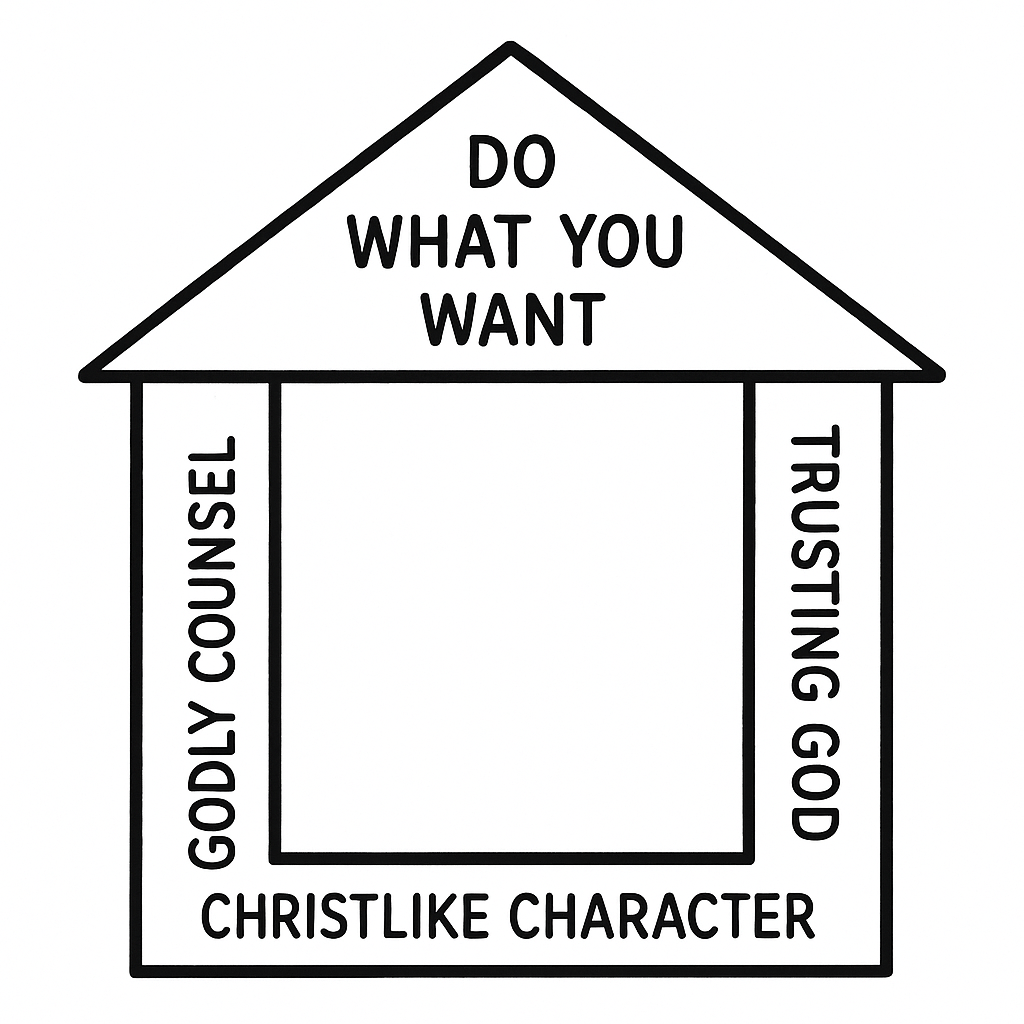
So today, from the book of Proverbs, I want to propose four principles for decision-making. They are principles that build together. If our decision making grid were a two dimensional drawing of a stick figure house, the first principle would be the foundation (or floor), the next two would be the walls, and the final principle would be the roof. Remember this image, because you cannot have the final principle without the first three.
1. Cultivate a Christlike Heart
Now, Proverbs doesn't directly tell us to cultivate a Christlike heart, because at the time of its writing, Jesus had not yet lived, died, and risen. But what Proverbs does tell us is that a major component of our lives ought to be the pursuit of integrity.
Consider these Proverbs:
- Proverbs 10:9: "Whoever walks in integrity walks securely, but he who makes his ways crooked will be found out." This statement highlights the idea that a person's internal character keeps them in the realm of safety. There is no secret laundry list of sins that might suddenly be exposed to derail their life. Because they are who they appear to be, they walk securely.
- Proverbs 11:3: "The integrity of the upright guides them, but the crookedness of the treacherous destroys them." As we've seen before, this proverb shows us that a person of internal character and holiness is guided by the very person they are. This helps us understand that cultivating personal holiness is of utmost importance because it helps you more naturally make good decisions. You are guided well because of your strong character.
- Proverbs 11:20: "Those of crooked heart are an abomination to the Lord, but those of blameless ways are his delight." This proverb encourages honest introspection. If we have cultivated a crooked heart—one that is opposed to the things of God—we will have a hard time being led by the Lord. But if we have cultivated a holy and blameless life in response to the blamelessness given to us by Christ, then we are under God’s delight and more easily led by him.
- Proverbs 14:22: "Do they not go astray who devise evil? Those who devise good meet steadfast love and faithfulness." What we see here is that God's own nature—his steadfast love and faithfulness—is ready to meet those who plan and scheme for good.
What we see in these texts, and throughout all of Proverbs, is that Proverbs is more concerned with character than it is with specific methods of discerning God’s will. The book doesn't focus on how God guides as much as it deals with whom God guides.
But this isn't what most people want to hear about receiving direction. Many people want something like a form of magic—little signs and feelings to determine the right decision. It’s not that God cannot lead that way, but it doesn’t seem to be his preference. Because he is our good Father, his aim is maturity. When children are little, parents will guide them with anything they can: star charts, treats, or promises of a favorite show. But we don’t use these methods when our children mature. You guide an adult by speaking to them so they understand and can make decisions on their own. The Lord seems to do the same with us. He wants to build up our Christlike heart so that we become people who are able to make better decisions.[^1]
This is, of course, the Spirit's ultimate aim. Romans 8 tells us the Spirit intercedes for us according to God's will (Rom. 8:27). And it says God works all things together for good for those who love him (Rom. 8:28). And if we need a clue as to how he is working things for good, the very next line tells us: "For those he foreknew he also predestined to be conformed to the image of his Son" (Romans 8:29). This is what the Spirit is praying for, what the Father is working for, and what the Son died for: that we might become like Jesus.
This personal transformation is a massive first step in making good decisions. Cultivating a Christlike heart means we allow the person of Jesus to redefine the "good life" for us. Paul referred to the crucifixion as "the power of God and the wisdom of God" (1 Corinthians 1:24). The wisdom of the cross introduces a new calculus to our lives, where success is no longer defined by avoiding suffering and accumulating wealth, but by conformity to Christ and the glory of God, even if it leads us through suffering. This is the first and most foundational step in decision-making: Cultivate a Christlike heart.
2. Receive Godly Counsel
The Proverbs are filled with passages urging us to receive wise and godly counsel. This isn't a replacement for the foundation of Christlike character, but a vital next step in our pursuit of wisdom.
- Proverbs 11:14: "Where there is no guidance, a people falls, but in an abundance of counselors there is safety."
- Proverbs 15:22: "Without counsel plans fail, but with many advisers they succeed."
- Proverbs 19:20: "Listen to advice and accept instruction, that you may gain wisdom in the future."
All of these passages nudge us toward good and abundant counsel, along with a readiness to receive it. However, the Proverbs also declare that we must pursue this counsel from the right sources. "The thoughts of the righteous are just; the counsels of the wicked are deceitful" (12:5). We must cultivate the right voices. Proverbs also says, "Faithful are the wounds of a friend; profuse are the kisses of an enemy" (27:6). It is always better to have a friend willing to say the hard thing than a friend who acts like an enemy by only saying what flatters.
In your pursuit of godly counsel, never neglect the two most direct and vital counselors you have: the Word of God and the Spirit of God in prayer.
Of course, the person cultivating a Christlike heart is already immersed in the Word, for it is there that we learn of Christ’s heart. It is through meditation on Scripture that we fellowship with him and are transformed. As you build your network of counselors, do not neglect this primary source. The Bible is the Word of Life; it is "a lamp to our feet and a light to our path" (Ps. 119:105) As we read it, study it, meditate on it, and journal what we’re learning, God’s own counsel grows within our hearts.
Then, alongside the Word, do not forget the incredible gift of prayer. God wants to counsel you. He has thoughts and impressions he desires to impart to shape your decision-making. Ask him for guidance. Be open to his divine intervention, whether he leads you directly or through the wisdom of others. Above all, be sure to pray. Seek his counsel.
It’s unlikely that many of us disagree with the idea that we should receive godly counsel. But I've found that many of us struggle to actually add this element to our lives. So, I’d like to offer some practical counsel on how to do so:
First, guard your heart against pride. A lack of humility will stop any hope of inviting good counsel into our lives. Ask yourself: Am I willing to listen? Am I interested in the perspectives of godly people? Am I ashamed and therefore unwilling to expose my struggles to another? Or do I think no one understands me or has a perspective able to help? If so, confess that pride, ask the Lord for forgiveness, and begin to pursue counsel.
Second, pursue a network of counselors. If we are waiting for a single, all-wise mentor to appear, we will likely be waiting a long time. Instead, aim for a "wisdom web" or a "personal board of directors." You might have someone in your network who is great on career, another on relationships, another on your walk with Christ, and another on managing finances. This diversified approach is realistic and effective.
Third, be intentional and initiate. We have been trained to follow algorithms and wait for influencers and podcasters to give us content, hoping wisdom will just soak in. But you must pursue your network with proactive hope, not passivity. Reach out. Make the call. Cultivate a list of questions. Be vulnerable.
Fourth, start at your local church. I realize we are a highly mobile society, but the church is God's intended hub for community.
- Look to your peers. Look around in your small group or life stage and find people you admire. You aren't in competition; you are there to complement and encourage one another.
- Look up. Who is ahead of you in life and seems to have what you want—a healthy marriage, family, or walk with the Lord? You don't have to put pressure on them by asking them to be your mentor. You can merely ask for a few minutes after a service, or for a cup of coffee to run some questions by them. Titus 2 teaches this intergenerational model. Many older saints feel their wisdom is unwanted; go to those you admire and ask.
- Look to your leaders. If you are committed to the church, remember that your pastors and elders can often provide critical counsel in a specific season or offer great spiritual direction.
When this is done, you can supplement your network with great resources—online voices, books, and other rich content—not just to consume, but to consider as counselors helping you get where you need to go.
3. Trust God
The Proverbs also acknowledge a paradox between our planning and the work of God. The book is full of exhortations to plan, work, and make wise decisions, but also calls us to trust in a sovereign God who ultimately directs our paths.
Several Proverbs beautifully capture this tension:
- Proverbs 16:9: "The heart of man plans his way, but the Lord establishes his steps."
- Proverbs 19:21: "Many are the plans in the mind of a man, but it is the purpose of the Lord that will stand."
- Proverbs 16:1-3: "The plans of the heart belong to man, but the answer of the tongue is from the Lord. All the ways of a man are pure in his own eyes, but the Lord weighs the spirit. Commit your work to the Lord, and your plans will be established."
Proverbs depicts God as working events according to his plan, while we are also presented as having freedom of choice. According to Scripture, both are simultaneously true. For instance, Jesus’s death on the cross was foreordained and absolutely determined by God, yet all the people who killed him were held responsible for their actions (Acts 2:23).
Theologians have long debated the specifics of how God works events according to his plan—from the meticulous providence view, where God controls every detail, to the total free will view, where humans have genuine freedom to make moral and spiritual choices and God watches it unfold, to the general providence view, which emphasizes significant human freedom within God's overarching plan. I don't think I'm going to solve that debate here today, but the Bible seems to portray God as both sovereign and relational, maintaining ultimate control while granting genuine freedom.
I'm pointing all this out to say that at the end of all our character-building, counsel-collecting, and diligent planning, we must simply trust the Lord.
God can and will help us in our decision-making, but we also need to rest in the understanding that he has a plan for our lives and for history, and he is working it out. He is all-powerful, infinitely loving, and perfectly wise. He "works out everything in agreement with the decision of his will" (Eph. 1:11, HCSB). And, for us, "we know that God causes all things to work together for good to love who love him, to those who are called according to his purpose" (Rom. 8:28, NIV).
This must lead us to a position of faith and trust. As you make decisions, there is a limit to how wise you can be, how informed you are, and how righteous your character is. All of us possess the "dark matter" of our own unmet expectations, upbringings, ulterior motives, and sinful tendencies that can dilute the purity of our decision-making.
In other words, if you are waiting around to make a perfect decision, you will be waiting for a very long time. It is better to trust that as we plan, as we prepare, and as we make our decisions—if we are walking with God and enjoying him—he is going to keep our lives on the path he desires for us.
If you think about it, so much of life has nothing to do with our decisions: the time and place you were born, your family of origin, your genetics, sickness, disease, accidents, chance encounters. A huge amount of life’s material is completely and totally beyond our control. We merely fall into it, accept it, and run with it. All of this should encourage us to trust in the Lord with all our heart, lean not on our own understanding, and in all our ways acknowledge him, trusting that he will make our paths straight (Prov. 3:5-6).
Remember, we serve the God who sent his only Son to live and die for us. When we place our faith in him, we enter into his covenant of steadfast love—a faithful, steadfast, unshakeable and unfailing commitment from God to care, tend, parent, bless, and favor his children. And, in all our planning and decision making, we must rest on this steadfast love of God. We must pursue holiness and wisdom, but after we make our decisions, even as we are making our decisions, we must trust he is with us, for us, and going before us, all because of the steadfast love he unleashed upon us at the cross.
4. Do What You Want
After calling us to cultivate a godly heart, receive wise counsel, and trust God, Proverbs encourages its readers to thoughtfully and diligently plan.
Consider Proverbs 24:27: "Prepare your work outside, get everything ready for yourself in the field, and after that, build your house."
Proverbs like these elevate practical wisdom and discernment. This is not esoteric or highly spiritualized guidance, but a best practice to follow. In essence, this proverb is saying you should evaluate how much income you are set to make before you decide how expensive of a house to build. Rather than starting with the lifestyle we think we deserve and working backward, we should practically consider the income we expect to earn and build from there. This is discerning planning.
Proverbs constantly encourages us toward planning. It tells us that "those who plan peace have joy" (12:20) and that "those who devise good meet steadfast love and faithfulness" (14:22). It says "the plans of the heart belong to man" (16:1) and that if we "commit our work to the Lord, our plans will be established" (16:3).
These verses help us understand why the pursuit of a Christlike heart is so critical to our planning. These proverbs do not suggest that we simply go to God and ask him to bless our plans as if he were a genie in a bottle. Instead, they call us to do everything as unto the Lord—to obey him in every area of our lives. When we are that kind of person, then we are equipped to make wise, realistic plans.
But what do we plan?
After you have cultivated a Christlike heart, received godly counsel from the Word and wise voices, and trusted that God ultimately directs your steps, do what you want. Or, as Professor Gerry Breshears puts it, do what makes you most deeply happy.
Again, this is not a standalone point. I would never lead with this or even consider it in isolation. It is only in the context of everything that has come before that we can say something like this. If you are living into your new identity in Christ, saturated with Scripture, trusting God as the Lord of your life, and have wisely considered your gifts and counted the cost of your decisions—if all those steps have been followed and multiple good options are in front of you, you are free to choose the one that brings you the deepest joy.
Unfortunately, many Christians are uncomfortable with this concept. They want a specific word from the Lord for every minor detail of life. Again, it's not that the Lord doesn't care about the details; it's that he wants to produce mature adults who can choose on their own, trusting that he will make their paths straight.
This discomfort often stems from a mystical view of our relationship with God—a perspective that can make us feel as if there is only one true will of God for our lives. One correct person to marry, one career to have, one place to live, and everything else misses God's will.
I've seen this illustrated with an image of a small dot in a galaxy of other options.[^2] It’s as if there is only one correct manifestation of the life God has for you. The pressure of this perspective is immense. It suggests that if you make one serious mistake, you will drive yourself off the course of God's perfect plan. The domino effect of such a view is paralyzing. If you choose to marry the "wrong" person, then that person was "meant" for someone else, and soon everyone is knocked off course for generations. Compared to the way the Bible describes God's will, this view is nonsense.

Instead, a more accurate image for decision-making would be a galaxy of dots representing many different choices, but with two lines running through it, creating a broad pathway. These lines represent the boundaries of God's moral will and revealed wisdom found in Scripture.
Inside those boundaries are tons of dots—many different careers, people, and places that are all good and God-honoring choices. The path we walk may twist and turn, but as long as we stay within those confines, we are living within God's purposes and plan. When we do make poor decisions and step outside those lines, the goal is repentance—to come back into the fold, within the confines of God's heart and will.

Conclusion
This framework—cultivating a Christlike heart, receiving godly counsel, trusting God, and exercising our freedom in Christ—is the biblical picture of decision-making. Remember the house I talked about? Here it is:
I'm not saying this makes our choices easy, and we will always, in this life, need to walk by faith. But this approach is so much more liberating. It invites us to focus on the vital work of developing character and growing in wisdom, all while making decisions that are steps of faith with God. This is better being us paralyzed by the fear of missing some single, perfect path we were meant to somehow discern.
This is a world away from groping through life for some mystical will, only to give up and live as if God doesn't care—or worse, as if he doesn't even exist. Instead, this framework reveals a Father in heaven who isn't hiding his will from us. He is raising us up as his holy children, walking with us to shape us into people of character and discernment—people who are equipped, over and over again, to choose a gospel-shaped life.
[^1]: Tim and Kathy Keller: God's Wisdom for Navigating Life
[^2]: Again, Dr. Gerry Breshears broke this down in a lecture I attended.